
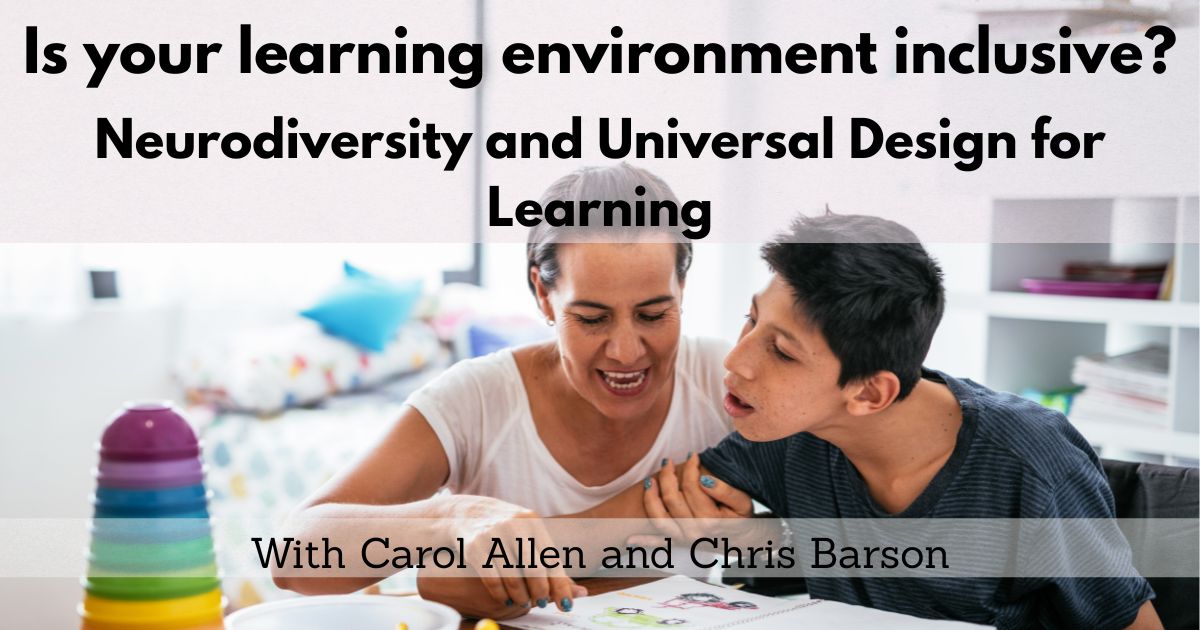
Is Your Learning Environment Inclusive?
12 November 2026: 9.30 am – 12.30 pm
This session will explore the nature of neurodiversity and how we anticipate and accommodate these differences in our learning environments.
For learners to be successful, we need to be proactive rather than reactive in shaping the learning environment.
We will explore the notion of universal design for learning to see how this can structure support for neurodivergent learners in the classroom.
Session 1: Getting started with UDL!
Carol will introduce the three core principles of UDL: Engagement, Representation, and Action & Expression and discuss how they combine to create an accessible educational offer for a wide range of learners with diverse learning needs.
Session 2: Neurodiversity? Neurotypical? Neurodivergent? What does it all mean?
Neurodiversity and universal design for learning go hand in hand. UDL is a practical way to plan teaching to ensure differences in how learners think, communicate, or process sensory information don’t become barriers in the classroom.
Session 3: Engagement
Engagement is the key to successful outcomes – without engagement, there is no learning. In this session, Carol will consider what engagement looks like for neurodiverse learners and how to build this into teaching using a learner’s special interests to shape tasks, choosing the right sensory “hooks”, and making small tweaks to resources, language, pace and expectations so the learner is more active in their learning. Carol will also discuss staffing: what adults should be doing and how to be consistent across a team in the classroom, even on busy days.
Session 4: Sensory good practice
Good sensory practice is about knowing your learners, understanding your environment, and putting simple systems in place so sensory support is consistent and effective. In this session, Chris will look at the core building blocks of sensory good practice in schools and settings.
Session 5: Multiple Means of Representation
In this final session, Carol and Chris consider how to accommodate multiple means of expression in UDL. Learners differ in the ways they navigate a learning environment, approach the learning process, and express what they know. Therefore, it is essential to plan, design and facilitate this from the beginning, so that learners have more than one way to take part and more than one way to show what they know.
9.30 am Admissions and a virtual tea/coffee to start the session!
9.35 am Welcome – and a warm up!
9.45 am Session 1: Getting started with UDL!
Carol will introduce the three core principles of UDL: Engagement, Representation, and Action & Expression and discuss how they combine to create an accessible educational offer for a wide range of learners with diverse learning needs.
10.15 am Session 2: Neurodiversity? Neurotypical? Neurodivergent? What does it all mean?
Neurodiversity and universal design for learning go hand in hand. UDL is a practical way to plan teaching to ensure differences in how learners think, communicate, or process sensory information don’t become barriers in the classroom.
In this session, Chris considers:
Where does the term neurodiversity come from?
Who do we mean when we say neurodivergent?
What is neurotypical?
10.45 am COFFEE
11.00 am Session 3: Engagement.
Engagement is the key to successful outcomes – without engagement, there is no learning.
In this session, Carol will consider what engagement looks like for neurodiverse learners and how to build this into teaching using a learner’s special interests to shape tasks, choosing the right sensory “hooks”, and making small tweaks to resources, language, pace and expectations so the learner is more active in their learning.
Carol will also discuss staffing: what adults should be doing and how to be consistent across a team in the classroom, even on busy days.
11.30 am Session 4: Sensory good practice
Good sensory practice is about knowing your learners, understanding your environment, and putting simple systems in place so sensory support is consistent and effective.
In this session, Chris will look at the core building blocks of sensory good practice in schools and settings:
Individual investigation
Audits for environments
Sensory profiles
Sensory plans
Carol will then explore how a sensory room fits into universal provision. She’ll look at how to use it properly: what it’s for, what it isn’t for, and how to plan sessions so the room leads to clear outcomes and impact rather than just “time in the sensory room”.
12.00 pm Session 5: Multiple Means of Representation
In this final session, Carol and Chris consider how to accommodate multiple means of expression in UDL. Learners differ in the ways they navigate a learning environment, approach the learning process, and express what they know. Therefore, it is essential to plan, design and facilitate this from the beginning, so that learners have more than one way to take part and more than one way to show what they know.
12.20 pm Q & A
12.30 pm Thank you and goodbye!
This course will be appropriate for classroom practitioners from special schools and colleges, mainstream settings with specialist SEN provision and early years settings, and working with pupils with severe/complex learning needs and autism, or both.
Find more about Chris Barson!
Find more about Carol Allen!
The cost is £165 plus VAT per delegate. You can select multiple places on the booking form.
You can pay by credit card for this booking or request an invoice on the booking form.
The recording of this event will be in your account at online.hirstwood.com. You will access this using the email address on the booking form and your password (instructions for creating your password are in the joining information).
Here you will find:
a digital recording of the event
a transcript of the Zoom chat
These will be available for 10 days after the event.
NEW for 2026!
We will suggest practical reflective practice for this event to support you in implementing your key takeaways from this session in the classroom.
We’ll also offer a toolkit of additional resources to help, which may include further documentation, videos or links to valuable resources/websites.
Please join our Facebook Group, Sensory Support Spaghetti, to connect with us and other like-minded professionals – for everything sensory!