
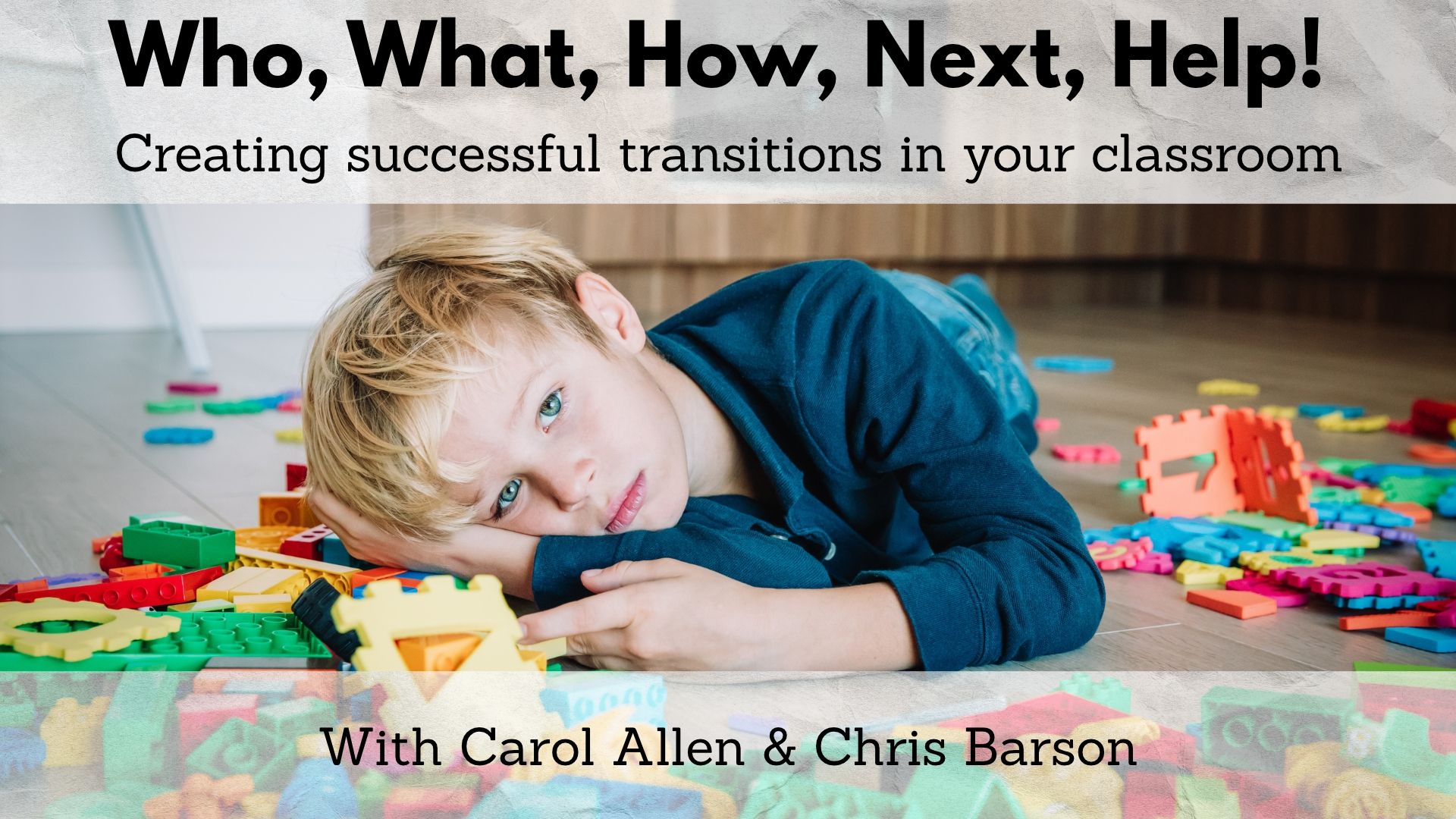
Who, What, How, Next, Help! Creating successful transitions
10 February 2027: 9.30 am – 12.30 pm
For many learners, navigating the dozens of daily micro-transitions in a school day can trigger profound anxiety, sensory overwhelm, and dysregulation.
When transitions break down, learning and behaviour suffer, stress levels rise, and learners lose the predictability they need to feel safe.
This session explores what we mean by transition, why it can feel so difficult, and how to reduce the boiling points that lead to refusal, distress, or escalation.
Chris and Carol move beyond generic countdown timers and explore tailored, proactive strategies: establishing clear roles (Who), clarifying expectations (What), structuring sensory and physical scaffolds (How), previewing upcoming shifts (Next), and embedding robust co-regulation pathways (Help!)
Whether you support learners with autism, ADHD, PDA, or complex sensory profiles, you will leave with actionable tools, visual frameworks, and shared team routines and strategies to make transitions more successful.
Session 1: Introduction to Transitions
In this first session, Carol asks:
What do we mean by transition?
How can problems with transitions impact learning and behaviour?
How can we minimise flashpoints in our teaching day?
Session 2: Why do autistic or neurodivergent learners have problems with transitions?
Chris continues by exploring:
The flexible thinking difficulties in autism
Problems with predicting
The need for ‘sameness’ and ‘predictability’
Session 3: Who? What? How?
In this session, Carol and Chris will cover:
Establishing clear roles and responsibilities
Clarifying expectations for learners
The importance of structuring sensory cueing and scaffolding
Individualised approaches
Session 3: Breakout Room – discussion & collaborative activity
Session 4: Next!
Chris and Carol now move on to:
Preparing for shifts and change
Strategies for home-to-school and school-to-home transitions
Movement around school, including assemblies, community events, corridors, and the dining hall.
Breaktime and outside areas
Session 4: Help!
In this final session, we explore:
embedding robust co-regulation strategies in classroom practice
sensory strategies to reduce overload
what is self-regulation?
building self-regulation skills without overwhelm
9.30 am Admissions and a virtual tea/coffee to start the session!
9.35 am Welcome – and a warm up!
9.45 am Session 1: Introduction to Transitions
In this first session, Carol asks:
What do we mean by transition?
How can problems with transitions impact learning and behaviour?
How can we minimise flash points in our teaching day?
10.00 am Session 2: Why do autistic or neurodivergent learners have problems with transitions?
Chris continues by exploring:
Why do autistic learners have problems with transition?
The flexible thinking difficulties in autism
Problems with predicting
The need for ‘sameness’
10.30 am Session 3: Who? What? How?
In this session, Carol and Chris will cover:
Establishing clear roles and responsibilities
Clarifying expectations for learners
The importance of structuring sensory cueing and scaffolding
Individualised approaches
11 am COFFEE
11.15 am Session 3: Breakout Room – discussion & collaborative activity
11.30 am Session 4: Next!
Preparing for shifts and change
Strategies for home-to-school and school-to-home transitions
Movement around school, including assemblies, community events, corridors, and the dining hall.
Breaktime and outside areas
12 pm Session 5: Help!
Embedding robust co-regulation strategies in classroom practice
Sensory strategies to reduce overload
What is self-regulation?
Building self-regulation skills without overwhelm
12.20 pm Q & A
12.30 pm Thank you and goodbye!
This course will be appropriate for classroom practitioners from special schools and colleges, mainstream settings with specialist SEN provision and early years settings, and working with pupils with severe/complex learning needs and autism, or both.
Find more about Chris Barson!
Find more about Carol Allen!
The cost is £165 plus VAT per delegate. You can select multiple places on the booking form.
You can pay by credit card for this booking or request an invoice on the booking form.
The recording of this event will be in your account at online.hirstwood.com. You will access this using the email address on the booking form and your password (instructions for creating your password are in the joining information).
Here you will find:
a digital recording of the event
a transcript of the Zoom chat
These will be available for 10 days after the event.
NEW for 2026!
We will suggest practical reflective practice for this event to support you in implementing your key takeaways from this session in the classroom.
We’ll also offer a toolkit of additional resources to help, which may include further documentation, videos or links to valuable resources/websites.
Please join our Facebook Group, Sensory Support Spaghetti, to connect with us and other like-minded professionals – for everything sensory!
Cost: £165 plus VAT per delegate