
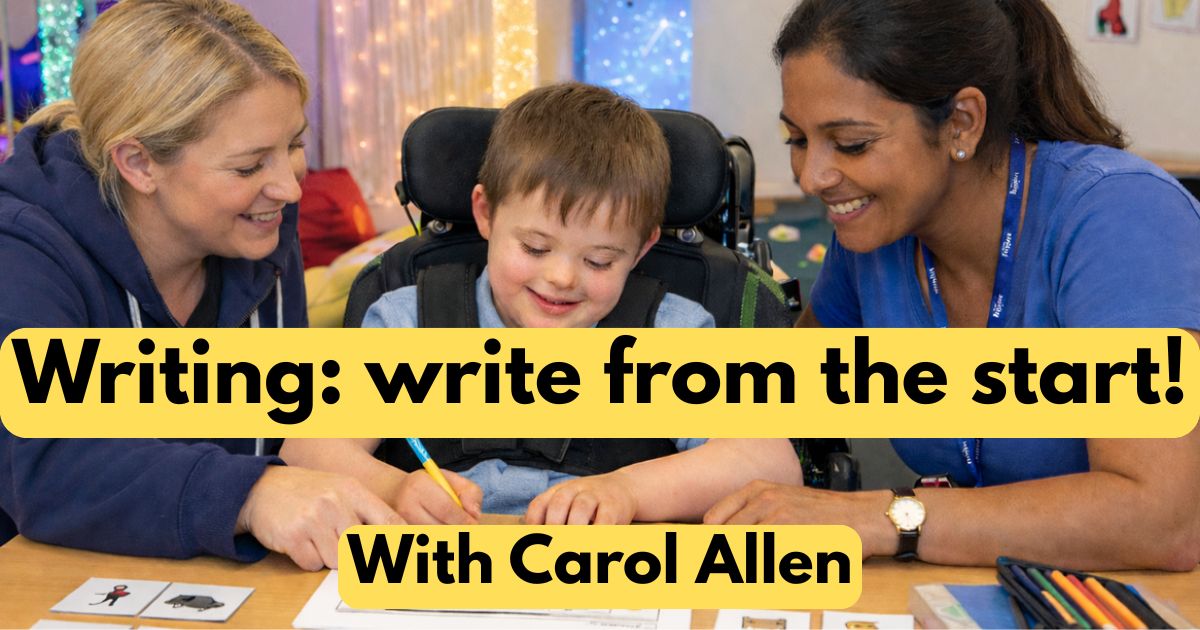
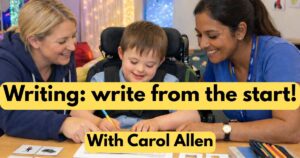
Writing: write from the start!
19 June 2026: 9.00 am – 12.00 pm
At the earliest stages, children begin to notice that pictures and print are not the same thing. You often see this first through play: how a learner “reads” a book, how they handle a pencil or stylus, where they place marks on a page, and whether they return to a familiar scribble or symbol as if it carries meaning.
For learners with PMLD, SLD and in EYFS, it’s never too early to break writing down into its smallest parts and teach those parts with intention. This session looks at what writing is before letter formation, what we can observe and build on, and whether more focused teaching can provide a firm basis for stronger outcomes over time.
Using a practical structure that combines theory and classroom application, Carol will cover the key issues to consider when promoting writing from the earliest stages for these learners.
You will leave with a plethora of practical, easy-to-replicate ideas for your classroom.
Session 1: Writing as a pillar for learning
Reading, writing, listening and speaking are the four pillars of communication, and all four work together to build a learner’s strengths and frame future teaching. In this session, we’ll look at the synergy between these elements and how to create an enabling environment which encourages and promotes writing from the very earliest stages.
Session 2: Purpose, Genre and Form
The purpose of writing is to capture thoughts and ideas and to share these with others. In this session, we’ll look at the different reasons we write and how purpose can shape the genre and form of writing from the earliest stages.
We’ll explore practical ways to introduce and develop four broad writing purposes:
Functional writing
Narrative writing
Informational writing
Poetic writing
Session 3: Targets to Facilitate and Support (Part A)
Writing has structure and form, so, from the earliest stages, we can identify and highlight key elements to raise awareness of them and develop strong foundations for later work. Firstly,we will consider:
The craft of writing: the building blocks that make writing possible
Writing conventions: the “rules” of writing which make writing make sense to other people
Session 4: Targets to Facilitate and Support (Part B)
In the second half of the session, we move from what writing is to how we help it happen, considering:
The Writing Process: how to teach writing as a simple, supportive sequence
The use of technology to remove barriers to motor control, attention, or access to tools makes traditional writing difficult.
Sharing and Publishing: simple, motivating ways to share learners’ writing to be seen and valued
Session 5: Breakout Room: collaborative activity
Session 6: I am a writer!
From the earliest ages, we need to empower our children to see themselves as writers. In this session, Carol will focus on empowerment and identity: how building a culture where writing, whether functional or creative, is normal, valued and part of everyday life for everyone is crucial to enable learners to experience writing as something they can do successfully!
9.00 am Admissions and a virtual tea/coffee to start the session!
9.05 am Welcome – and a warm up!
9.10 am Session 1: Writing as a pillar for learning
Reading, writing, listening and speaking are the four pillars of communication, and all four work together to build a learner’s strengths and frame future teaching. In this session, we’ll look at the synergy between these elements and how to create an enabling environment which encourages and promotes writing from the very earliest stages.
9.30 am Session 2: Purpose, Genre and Form
The purpose of writing is to capture thoughts and ideas and to share these with others. In this session, we’ll look at the different reasons we write and how purpose can shape the genre and form of writing from the earliest stages.
We’ll explore practical ways to introduce and develop four broad writing purposes:
Functional writing
Narrative writing
Informational writing
Poetic writing
10.00 am Session 3: Targets to Facilitate and Support (Part A)
Writing has structure and form, so, from the earliest stages, we can identify and highlight key elements to raise awareness of them and develop strong foundations for later work. Firstly,we will consider:
The craft of writing: the building blocks that make writing possible
Writing conventions: the “rules” of writing which make writing make sense to other people
10.30 am COFFEE
10.45 am Session 4: Targets to Facilitate and Support (Part B)
In the second half of the session, we move from what writing is to how we help it happen, considering:
The Writing Process: how to teach writing as a simple, supportive sequence
The use of technology to remove barriers to motor control, attention, or access to tools makes traditional writing difficult.
Sharing and Publishing: simple, motivating ways to share learners’ writing to be seen and valued
11.15 am Session 5: Breakout Room: collaborative activity
11.30 am Session 6: I am a writer!
From the earliest ages, we need to empower our children to see themselves as writers. In this session, Carol will focus on empowerment and identity: how building a culture where writing, whether functional or creative, is normal, valued and part of everyday life for everyone is crucial to enable learners to experience writing as something they can do successfully!
11.50 pm Q & A
12.00 pm Thank you and goodbye!
This course will be appropriate for classroom practitioners from special schools and colleges, mainstream settings with specialist SEN provision and early years settings, and working with pupils with severe/complex learning needs and autism, or both.
Find more about Carol Allen!
The cost is £149 plus VAT per delegate. You can select multiple places on the booking form.
You can pay by credit card for this booking or request an invoice on the booking form.
The recording of this event will be in your account at online.hirstwood.com. You will access this using the email address on the booking form and your password (instructions for creating your password are in the joining information).
Here you will find:
a digital recording of the event
a transcript of the Zoom chat
These will be available for 10 days after the event.
NEW for 2026!
We will suggest practical reflective practice for this event to support you in implementing your key takeaways from this session in the classroom.
We’ll also offer a toolkit of additional resources to help, which may include further documentation, videos or links to valuable resources/websites.
Please join our Facebook Group, Sensory Support Spaghetti, to connect with us and other like-minded professionals – for everything sensory!